Einstein and the Assumption of Absolute Time
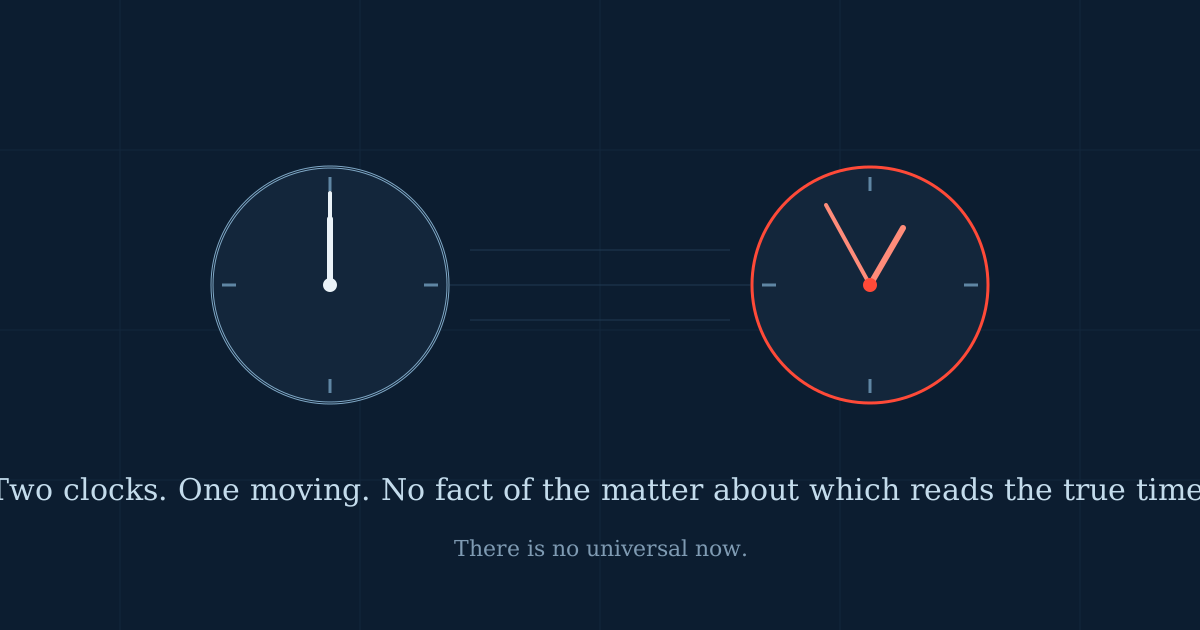
There is no universal now. Einstein didn't merely solve a physics problem, he refused the assumption that everyone, everywhere, shares the same moment.
When Einstein was sixteen, he asked himself what you would see if you chased a beam of light and caught up to it.
The answer should have been obvious. Run alongside a train and it slows, relative to you; match its speed and it hangs still beside you. Light should behave the same way. Ride fast enough and the wave should freeze, a frozen pattern of electric and magnetic fields, hanging in space.
The trouble is that no such thing exists. Maxwell’s equations, which had unified electricity, magnetism, and light into one of the great triumphs of the century, did not permit a frozen light wave. Light, they said, travels at one fixed speed, c, and that was that. So the boy’s question had no comfortable answer: either the most successful theory of physics was wrong, or something everyone took for granted about speed, motion, and time was wrong.
It took him nine years to follow that crack to the bottom. What he found there was not a mistake in anyone’s arithmetic. It was an assumption so deep that nobody had thought to write it down.
The stage nobody questioned
For two hundred years, physics had stood on Isaac Newton’s picture of the world, and it was a magnificent one. It predicted the planets, the tides, the return of comets. It worked so well that its foundations stopped looking like choices and started looking like reality itself.
Underneath it sat an assumption Newton stated plainly and never doubted:
Time is absolute, a single cosmic clock ticking at the same rate for everyone, everywhere, independent of anything that happens.
In the Principia he wrote that “absolute, true, and mathematical time, of itself, and from its own nature, flows equably without relation to anything external.” There is one now, universal and shared. Two events anywhere in the universe are either simultaneous or they are not, and the answer is the same for everyone. This is so obviously true that it feels strange even to say it. Of course “now” is the same everywhere. What else could it possibly be?
That feeling, what else could it possibly be?, is the exact sensation of standing on a load-bearing assumption. It isn’t that you have weighed the alternatives and chosen this one. It’s that the alternatives are unthinkable, because the assumption is built into the words you would have to use to doubt it. “At the same time” already assumes a universal time in which things can be “the same.”
When two trusted ideas collide
By 1900 the cracks the boy had felt were everywhere, and they took a specific shape. Physics now held two ideas, each extremely well-supported, that could not both be true.
The first was the principle of relativity, inherited from Galileo and Newton themselves: the laws of physics are the same for everyone moving at a steady speed. There is no experiment you can do inside a smoothly sailing ship to tell whether you are moving or standing still. Motion, in this sense, is always relative. There is no privileged stationary observer.
The second was Maxwell’s fixed speed of light. The equations gave one value of c, full stop.
Put them together and you get a contradiction, if you keep absolute time. With a universal clock and ordinary common sense, speeds add: throw a ball forward on a moving train and the ground sees it move at train-speed plus throw-speed. So a beam of light chased by a fast observer should arrive slower. But Maxwell says its speed is fixed, and the relativity principle says the chaser’s own physics must look completely normal to him.
This is what a paradox actually is: not a mystery, but a set of commitments that cannot all be true at once. And resolving one always costs the same thing: you must give up one of the commitments. The only question is which. Lay them out:
- The principle of relativity holds (no privileged frame).
- The speed of light is constant for everyone.
- Time is absolute (one universal clock; speeds add the ordinary way).
Any two of these can be true together. All three cannot. So one has to be relaxed, and which one you choose to relax is itself a decision, usually an invisible one.
For twenty years the argument was treated as a fork with only two prongs: give up the relativity principle, or give up the constancy of light. Those were the moves everyone could see. The third option, give up absolute time, was not rejected. It was never reached, because it didn’t look like a commitment that could be on the list at all. The first two were physics; the third was just… how time is. Absolute time wasn’t on the table as an assumption to be questioned. It was the table.
So almost everyone held assumption 3 fixed without noticing they were holding anything, and went to war over 1 and 2. Most tried to save the situation by adding machinery to absolute space. They supposed light travelled through an invisible medium, the aether, that filled the universe and defined a true rest frame, which was, quietly, a way of relaxing assumption 1, since a true rest frame is exactly the privileged perspective the relativity principle denies. Holding time sacred, they were willing to give up relativity instead. Then the famous Michelson–Morley experiment went looking for the Earth’s motion through this aether, and found nothing. No wind, no drift, no variation in the speed of light at all. To patch the hole, Lorentz and FitzGerald proposed that moving objects physically shrink and their clocks physically slow, by just the right amount to hide the effect. The mathematics they wrote down was, remarkably, almost exactly the mathematics Einstein would use. They had the equations. What they did not have was the willingness to give up the right assumption.
The assumption Einstein refused
Einstein’s move was not to compute harder. It was to take the third option, the one that wasn’t on the list, and relax the commitment nobody else would touch.
He held assumptions 1 and 2 fixed. The principle of relativity stayed. The constancy of the speed of light stayed, promoted from a result to a starting assumption: light moves at c for every observer, no matter how fast they are moving. That left only one thing to give, and he gave it. The cosmic clock.
Two events that happen “at the same time” for one observer need not happen at the same time for another. Simultaneity is not a fact about the universe; it is a fact about an observer.
Picture lightning striking both ends of a moving train. To someone standing on the embankment at the midpoint, the two flashes arrive together: simultaneous. But a passenger at the centre of the train is rushing towards one flash and away from the other. The light from the front reaches her first. For her, the strikes were not simultaneous: the front was hit before the back. Neither is mistaken. There is no further fact, no view from the cosmic clock tower, that settles who is “really” right. The universal now was never there to consult.
Once simultaneity goes, the rest follows without contradiction. Moving clocks run slow; moving lengths contract, not as a mechanical squeezing inside an aether, but because time and space themselves are measured differently by observers in motion. The aether becomes unnecessary and quietly disappears: there is no universal stationary frame because there is no universal time to anchor it. The same equations Lorentz wrote to protect absolute space, Einstein derived by abandoning it.
The clocks really disagree
It would be easy to file this under philosophy, a clever way of talking with no consequence you could ever touch. That is backwards. The relaxed assumption makes predictions the sacred one does not, and every time we have checked, reality has sided with it.
The vivid version is the twin paradox: one twin travels away near light-speed and returns younger than the brother who stayed. It sounds symmetric: if motion is relative, why isn’t each the slow one to the other? Because it isn’t symmetric. Only the traveller turns around, switching frames to come home, and that breaks the tie. One of them genuinely ages less, and there is no universal clock to overrule it.
And it is measured, routinely. Muons born when cosmic rays strike the upper atmosphere should decay long before reaching the ground, yet they arrive in abundance. At their speed, time dilation buys them the trip. In 1971, Hafele and Keating flew atomic clocks around the world on airliners, and they returned disagreeing with the clocks left home by the fraction of a microsecond the theory predicted. GPS would drift kilometres a day if it ignored the effect. Part of that is gravity (the next piece), but part is pure motion.
The assumption everyone kept because it was obvious is false, and we can measure how false. The conclusion everyone resisted because it was absurd is true, to the microsecond.
What actually changed
This is the part worth keeping, long after the equations blur.
Lorentz had the mathematics and missed the revolution, because he treated his formulas as tricks for preserving the old stage. Einstein treated the same formulas as a description of a new one. Nothing in the data forced the difference between them. What separated a patch from a revolution was a decision about which assumption was allowed to be wrong.
And the assumption that turned out to be wrong was not one anyone had argued for. Newton defended many things, but not absolute time. He simply built on it, the way you build on the floor without first proving the floor is there. That is what makes this kind of assumption so dangerous and so durable:
The hardest assumptions to question are not the claims you believe. They are the stage your beliefs stand on, so deep they hide inside the words you would need in order to doubt them.
You cannot easily question “now” using a language in which “now” is the unspoken reference for every other word. Einstein’s genius was less mathematical than grammatical: he heard the assumption hiding inside “at the same time,” and asked whether it was a fact about the world or a fact about the speaker.
It was a fact about the speaker. The universal clock, the one thing more certain than the ground, was a setting in the observer, not a feature of the cosmos.
That dissolved absolute time. But absolute space still stood, and so did the strangest thing in all of Newton’s system: a force that reached across empty space, instantly, to pull on worlds it never touched. Newton himself had called it an absurdity, and then asked everyone to use it anyway. Refusing that assumption would take Einstein another decade, and it would turn out to require breaking the stage entirely.
That is the next piece.
Sources
- Isaac Newton, Philosophiæ Naturalis Principia Mathematica (1687), the Scholium on absolute, true, and mathematical time.
- Albert Einstein, “Autobiographical Notes” (1949), the boyhood thought experiment of chasing a beam of light.
- Albert Einstein, Relativity: The Special and the General Theory (1916), the train-and-embankment illustration of simultaneity.
- J. C. Hafele & R. E. Keating, “Around-the-World Atomic Clocks,” Science (1972), flying clocks confirm time dilation.