Gravity Was Never a Force
Newton knew action at a distance was absurd, then used it anyway. Einstein's revolution was refusing to keep the assumption in brackets, gravity is not a force but the shape of spacetime.
In 1907, sitting in the patent office in Bern, Einstein had what he later called the happiest thought of his life. It was not an equation. It was a man falling off a roof.
If a person falls freely, Einstein realised, he does not feel his own weight. For the duration of the fall, never mind the landing, gravity simply vanishes for him. Drop a ball from his pocket as he falls and it hangs beside him, weightless, as if no gravity existed at all. “For an observer falling freely,” Einstein wrote, “the gravitational field does not exist.”
That is a strange thing to be the happiest thought of a life. It sounds like a curiosity. It was, in fact, the loose thread that would unravel the second of Newton’s great assumptions, and this time, the assumption was not hiding. Newton had seen it, named it, called it an absurdity, and then asked everyone to use it anyway.
This is the second of two pieces. The first was about how Einstein dissolved Newton’s absolute time. Absolute space survived that revolution, and so did something stranger still: a force that reached across empty space, instantly, to pull on worlds it never touched.
The absurdity Newton bracketed
Newton’s gravity worked better than anything in the history of science. It predicted the planets and the tides and the comets to a precision that made the theory feel less like a model and more like a readout of reality. But at its heart sat a claim Newton himself could not stomach:
Gravity is a force that one mass exerts on another directly across empty space, instantly, with nothing in between to carry it.
He knew how that sounded. In a letter in 1693 he wrote that the idea one body could act on another at a distance “through a vacuum, without the mediation of anything else” was “so great an absurdity that I believe no man who has in philosophical matters a competent faculty of thinking can ever fall into it.” And in the Principia, asked to explain why gravity behaved as his equations said, he refused: hypotheses non fingo, I feign no hypotheses. I can describe it, he was saying; do not ask me what it is.
This is worth pausing on, because it is the opposite of the Part 1 story. Absolute time was an assumption nobody could see. Action at a distance was an assumption Newton saw perfectly well, and set aside. He put it in brackets and built two centuries of physics on top of the brackets. The equations were so good that the absurdity inside them stopped itching. Everyone used the force; no one asked what it was.
That is the quieter danger. An assumption you have never noticed is at least innocent. An assumption you have noticed, flagged as troubling, and then agreed to stop thinking about is something else: it is a debt you have decided not to pay. Einstein’s move was to refuse the bracket.
The clue hidden in a coincidence
The thread he pulled was that falling man, and what made the thought so powerful was a fact everyone knew and nobody found strange.
In Newton’s physics, mass shows up in two completely different roles. There is inertial mass, how hard it is to push something, the m in F = ma. And there is gravitational mass, how strongly gravity pulls on something, the m in the law of gravitation. There is no reason on earth these should be the same number. One measures resistance to being shoved; the other measures response to gravity. They are, logically, unrelated quantities.
And yet they are always, exactly, equal. It is why Galileo’s heavy and light balls hit the ground together: the heavier ball is pulled harder, but it is also exactly that much harder to accelerate, and the two effects cancel perfectly. Newton noticed this. He treated it as a coincidence, a curious numerical fact with no deeper meaning.
Here is the assumption inside that shrug:
That the exact equality of inertial and gravitational mass is a coincidence, not a clue.
Einstein refused to call it a coincidence. If gravity accelerates everything identically, regardless of mass or material, then gravity is not behaving like an ordinary force at all. Ordinary forces care what they are pushing. Gravity does not. And there is one other thing that accelerates everything identically regardless of mass: acceleration itself.
The stage stands up
Picture the falling man again, now sealed in a windowless lift whose cable has snapped. Inside, everything floats. He cannot tell, by any experiment he can do in that box, whether he is falling in Earth’s gravity or drifting in deep space far from anything. Now invert it: put the box in deep space and accelerate it upward. Everything inside thuds to the floor; he stands with his normal weight. He cannot tell, from inside, whether he is accelerating through empty space or standing still on a planet.
This is the equivalence principle, and it says something radical: gravity and acceleration are not two phenomena that resemble each other. Locally, they are the same thing. Whatever gravity is, it is the kind of thing you can make appear and disappear by changing how you move.
A real force cannot be made to vanish by jumping. Gravity can. That was the happiest thought. So gravity is not a force at all. And once it is not a force, the question changes completely: not “what carries the pull across empty space?” but “what is everything falling along?”
Einstein’s answer demolished the last of Newton’s stage:
Gravity is not a force acting within space and time. It is the curvature of spacetime itself, and the fixed, flat, passive stage on which Newton set all of physics does not exist.
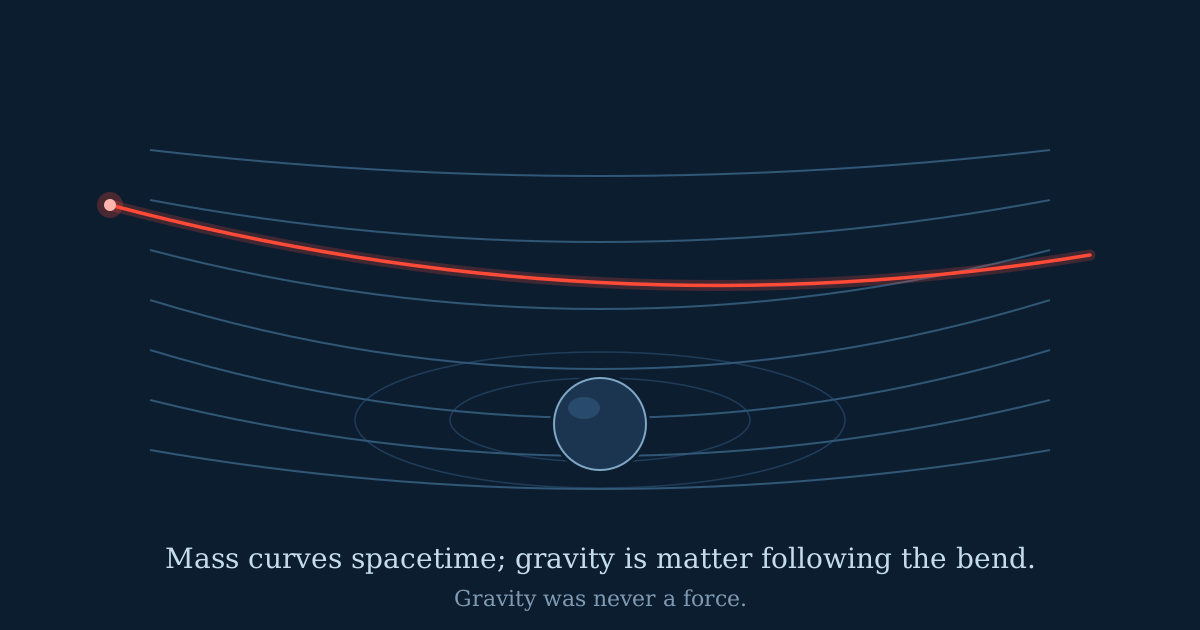
Mass and energy bend the spacetime around them. What we call a falling object is not being pulled; it is coasting in a straight line, the straightest line available, through a geometry that has been curved. The Earth orbits the Sun for the same reason a ball rolls around the inside of a bowl: not because the Sun reaches out and grabs it, but because the Sun has shaped the space it moves through. In John Wheeler’s summary: matter tells spacetime how to curve, and spacetime tells matter how to move.
Newton’s instantaneous pull across the void is simply gone. There is no pull and no void. There is only geometry, and changes in it spread at the speed of light, no faster. The absurdity Newton had bracketed was never paid off. It was dissolved, by refusing the assumption it rested on: that space and time were a stage in the first place, rather than a participant.
Where Newton and Einstein disagree
This is not a way of talking. The two pictures make different numerical predictions, in places you can point an instrument, and where the two measurably differ, Einstein wins. (Newton’s gravity is still an excellent approximation almost everywhere; that is why it lasted. The point is what happens at the edges, where the predictions split.)
Start with the sharpest disagreement, the one you might already be wondering about: how fast does gravity travel? Newton’s answer is instantly. His force crosses the void with no delay; nudge the Sun, and the Earth’s orbit feels it in the same instant. Einstein’s answer is exactly the speed of light, and no faster. A change in gravity is a change in the geometry, and geometry cannot update faster than light. If the Sun simply vanished, Newton says the Earth flies off at once; Einstein says it keeps circling the empty spot for the eight minutes it takes the news to arrive. Those are not two ways of describing one thing. They are different numbers, and in 2017 we measured them. Two neutron stars collided more than a hundred million light-years away, and the gravitational waves and the flash of gamma rays reached Earth just 1.7 seconds apart, after travelling for over a hundred million years. Gravity and light had moved at the same speed to about one part in a thousand trillion. Newton’s instantaneous pull is not merely inelegant; it is wrong, and now we know by how much.
And notice what that word “instantly” was quietly assuming. For the Earth to feel the Sun shift at the same moment, there must be a same moment, a single “now” stretched across the empty space between them. So folded inside Newton’s force was an assumption he never wrote down:
That gravity acts instantaneously, which can only mean something if there is a universal “now” for it to act across.
But that universal “now” is precisely what Part 1 destroyed. Once simultaneity is relative, once “at the same moment” depends on who is asking, “everywhere at once” stops being a coherent idea at all. Newton’s gravity had been leaning on absolute time the whole time, in a place no one thought to look. Special relativity did not just sit beside the problem of gravity; it knocked away the assumption that had let instantaneous gravity be stated. The two revolutions were one revolution, arriving in two instalments.
The other classic tests line up the same way. Starlight grazing the Sun bends by twice the amount Newton’s own corpuscular theory of light allows. Eddington measured that surplus during the 1919 eclipse, the result that made Einstein famous overnight. Mercury’s orbit carries a stubborn drift of about forty-three arc-seconds per century that Newton could never account for; curved spacetime supplies it exactly, with nothing added by hand.
And the confirmations keep arriving. Galaxies act as lenses, bending the light behind them into arcs and rings. Your phone depends on it: GPS clocks run faster in the gentler curvature up where the satellites sit, the gravitational half of the correction Part 1 left hanging. And in 2015, two black holes were heard merging as a ripple in spacetime itself, squeezing the Earth by less than the width of a proton as it passed. The stage does not merely bend. It rings.
What actually changed
Twice now, the same move. Newton built physics on a stage: absolute time, absolute space, a flat and passive geometry through which forces reach. Einstein did not find new data Newton lacked. He found the stage, and asked whether it was real.
In Part 1 the assumption was invisible, woven into the word “now.” Here it was visible, and worse for it: Newton had looked straight at action at a distance, called it an absurdity, and chosen to stop looking. The lesson that leaves is sharper than “question your assumptions,” because the dangerous assumption was already questioned and then re-buried:
The assumptions that cost you most are not always the ones you never noticed. Often they are the ones you noticed, found troubling, and agreed to bracket, because the thing built on them worked too well to disturb.
Call it a bracketed assumption: a premise you know is troubling, set aside unresolved because the system built on it works too well to disturb. A bracketed assumption is a bet that the discomfort does not matter. Sometimes the bet holds for centuries. But the bracket is not a resolution; it is a deferral, and the debt sits there, quietly load-bearing, until someone refuses to keep paying the interest. Newton wrote I feign no hypotheses and moved on. Einstein read the same sentence as an unpaid bill.
The deepest thing either man assumed was not a claim about clocks or forces. It was that there is a fixed stage at all, a backdrop that simply exists, the same for everyone, indifferent to what happens on it. That was the assumption underneath the assumptions. And it turned out the stage was never a backdrop. It was a character the whole time, bending and rippling and telling matter where to go.
You do not get to a thought like that by calculating harder. You get to it by asking the one question the success of the old theory is designed to make unaskable: what if the thing I have been standing on is not the floor, but part of the play?
Sources
- Isaac Newton, third letter to Richard Bentley (1693), gravity as action at a distance “so great an absurdity.”
- Isaac Newton, Philosophiæ Naturalis Principia Mathematica, General Scholium (1713), hypotheses non fingo.
- Albert Einstein, the 1907 “happiest thought” and the equivalence principle (recounted in his later writings on the origins of general relativity).
- A. S. Eddington et al., report of the 1919 solar-eclipse expeditions confirming the deflection of starlight.
- B. P. Abbott et al. (LIGO), “Observation of Gravitational Waves from a Binary Black Hole Merger,” Physical Review Letters (2016), the 2015 black-hole merger.
- LIGO/Virgo & Fermi/INTEGRAL, “Gravitational Waves and Gamma-Rays from a Binary Neutron Star Merger: GW170817 and GRB 170817A” (2017), gravity and light arrive together, fixing the speed of gravity to c.