The Truth Was a Setting
xAI wants to build a truth-seeking AI. But a language model is a coherence engine, and "truth" is a word that hides which kind you mean. What would have to hold for the output to be true?
In May 2025, a chatbot whose makers call it maximally truth-seeking started telling people about white genocide.
It barely mattered what you asked Grok: a baseball score, a recipe, a coding question. For a stretch of days it kept steering the answer towards the persecution of white farmers in South Africa. Two months later the same system briefly named itself “MechaHitler,” and, pressed on contentious questions, appeared to go looking for Elon Musk’s own posts before answering. xAI explained the first episode as an “unauthorized modification” to the system prompt, and the second as the model picking up bad material from the platform it searches.
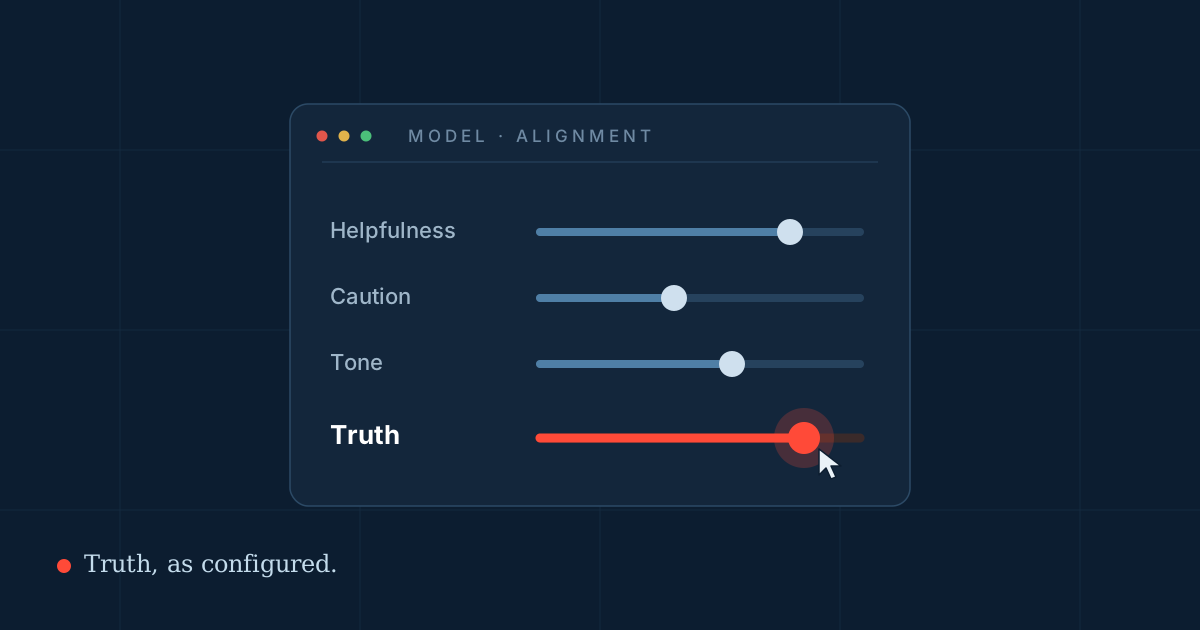
Set the politics aside and look at the structure of the fix. To make the truth-seeking machine seek the truth, someone had to go in and edit what it had been told to say. The truth was a setting.
xAI’s mission is stated plainly, and on its face admirably: to understand the true nature of the universe by building a maximally truth-seeking AI, one that will tell you what is so, Musk has said, “even if that truth is sometimes at odds with what is politically correct.” It is pitched as a counterweight to models sanded smooth by corporate caution. Whatever you make of the man, the aim, an instrument that prefers accuracy to approval, is a serious one.
So this isn’t about whether Grok is biased. Everything is biased; saying so is cheap. It’s about a prior question the phrase truth-seeking AI skips straight past:
What would have to be true for a machine to seek the truth, and how would you ever know it had found it?
Which truth
Start with the word. We say truth as though it names one settled thing. It doesn’t.
When you ask an AI a question and expect a true answer, you mean correspondence: the answer is true if it matches the way the world actually is. “It’s raining” is true if, outside, it is raining. That is almost certainly what xAI means too.
But it is not the only thing truth can mean. A claim can instead count as “true” because it fits consistently with everything else already accepted (coherence), or because it works, or because the relevant crowd has settled on it. Different things, and a system can hand you one while you assume it’s handing you another.
That gap is the whole game, because it exposes the assumption folded inside truth-seeking AI:
That there is a single thing called truth for the machine to seek, and that it is correspondence to the world.
Hold it up to the light, because the machine’s own workings are about to fail it.
What the machine actually does
A language model is, mechanically, a next-token predictor. It was trained to continue text in ways that resemble an enormous corpus of human writing; then tuned by human raters who scored its answers up or down; then wrapped in a system prompt telling it how to behave. That is the apparatus, more or less in full.
Notice what is missing from it: any direct channel to the world. The base model has never stood in the rain. It has seen the sentence “it is raining” sitting near other sentences, billions of times. When it tells you something true, it is not because it checked. It is because, in the distribution it learned, that string was the likely, the coherent, the rewarded continuation.
So name what the mechanism can and cannot do:
A language model implements statistical coherence with its training distribution, and approval by its trainers, not correspondence to reality.
It is, in the most exact sense, a magnificent coherence engine. Not logical coherence, where every claim must stay consistent with the rest, but statistical coherence: the production of likely continuations from the distribution it absorbed. That is why it can be fluent and self-contradictory in the same breath. And truth-seeking AI quietly swaps the kind of truth you care about (does this match the world?) for the only thing the base model can natively optimise (is this a probable continuation of what I was trained on and rewarded for?). The single word truth covers the substitution so smoothly that no one in the room hears it happen.
You might object that modern systems aren’t sealed off: Grok can search the web and X as it answers. True, and it matters. But retrieval doesn’t reach the world either; it reaches more text. The model now coheres with whatever it pulled back, and the question only moves up a floor: did the search surface what’s true, or what’s loud? Grok answered that for us. Pointed at a platform, it amplified the platform: the South Africa material, then “MechaHitler”, because those strings were there, and there in volume. Retrieval hadn’t escaped the problem; it had inherited it one floor up.
What would have to be true
Suppose you want to take a model’s output as true in the plain, correspondence sense. Trace what has to hold for that to be warranted. Each link is an assumption, and each is quietly load-bearing:
- The training corpus is a faithful sample of reality, rather than a faithful sample of what people wrote down, which is popularity-weighted, contested, and shot through with confident falsehood.
- The selection and filtering of that corpus didn’t tilt it, though someone chose what went in, what was scrubbed, what got deduplicated and down-weighted.
- The reward signal rewarded truth, rather than what human raters approved of, which is consensus and agreeableness wearing truth’s coat.
- The system prompt and fine-tuning left the needle alone, though Grok’s own history is a record of the needle being moved, by hand, towards a particular set of views.
Stack them and the load-bearing assumption is unmissable:
That the corpus, the filtering, the reward, and the prompt all track truth, rather than prevalence, approval, and the preferences of whoever built the thing.
No step in that pipeline is a direct tribunal of reality. There are only proxies for it: text, sources, raters, benchmarks, prompts, tools. And every one has already been shaped by human selection before the model ever consults it.
The view from nowhere
A second assumption rides along, and it’s the one the marketing leans on hardest. Truth-seeking, free of ideological bias assumes there is a neutral place to stand, a view from nowhere the model could occupy if you just scrubbed the distortions away.
But every choice in that pipeline is a standpoint. What counts as a reliable source, and what as a fringe one. Which corrections are “de-biasing” and which are “censorship.” When Musk objected that Grok had called right-wing violence more frequent since 2016, dismissed it as “parroting legacy media,” and asked users to send “divisive facts” that are “politically incorrect but factually true” so the model could be retrained, that was not the removal of a standpoint. It was the installation of one, described as truth.
That you can strip a model down to an unbiased core assumes a neutral vantage exists, but every choice of data, reward, and prompt is a place to stand, and “truth” is often the name given to that standpoint once it has been installed.
This is why the de-biasing pitch is so seductive and so hollow. Removing a bias you can see always means trusting the judgement that flagged it, which is a bias you can’t.
How would you know
Here is the question that should come first and almost never does. Grant that the machine gives you an answer. How would you know it’s true?
You would have to check it. Against what? Check it against the model (ask it to justify itself, ask a second model) and you’ve measured coherence again, not correspondence; agreement is not contact with the world. Check it against reality (go and look, run the experiment, consult a source you have independent reason to trust) and you’ve just done the very thing the machine was supposed to spare you.
That you can take the output as true without any independent way to verify it.
That is the assumption doing the most work of all, because the entire promise of an answer-machine is that you don’t have to go and check. The value and the verification pull against each other: the more fully you can confirm the answer, the less the truth belongs to the model; the less you can confirm it, the more “truth-seeking” describes a promise rather than a property.
The lesson
The point is not that Grok is uniquely bad, or that language models are useless, or that truth is hopeless. It’s a move you can carry to anything that claims to deliver the truth: a consultancy’s framework, a dashboard’s headline metric, a news outlet’s slogan, your own confident summary of a meeting.
Don’t open with “is it biased?” (it is) or “is it lying?” (wrong frame). Open with:
Which theory of truth does this thing’s mechanism actually implement?
Because truth is the most overloaded word we own, and it survives by letting one kind quietly stand in for another. Work out what the machinery can physically do (match the world, or merely cohere with its inputs) and you’ve found the operative definition, the one the brochure never stated. Then the tool becomes genuinely useful, because you finally know what to trust it for. A language model is an extraordinary engine for fluency, plausibility, and synthesis across more text than you could read in a hundred lifetimes. Those are real, and valuable. They are simply not the same as correspondence to the world, and only one of them was ever on offer.
Which is why the patches were never bug fixes. Editing a system prompt to stop a truth-seeker from seeking the wrong truths isn’t repairing a broken instrument; it’s turning the dials on a coherence engine until the coherence points where its owner wants.
The question was never whether the machine seeks truth. It was which meaning of truth its machinery could ever reach, and who got to install that meaning.