The Black Swan and the Fragility of Assumptions
The Black Swan and the Fragility of Assumptions
Introduction: When a Bird Broke Philosophy
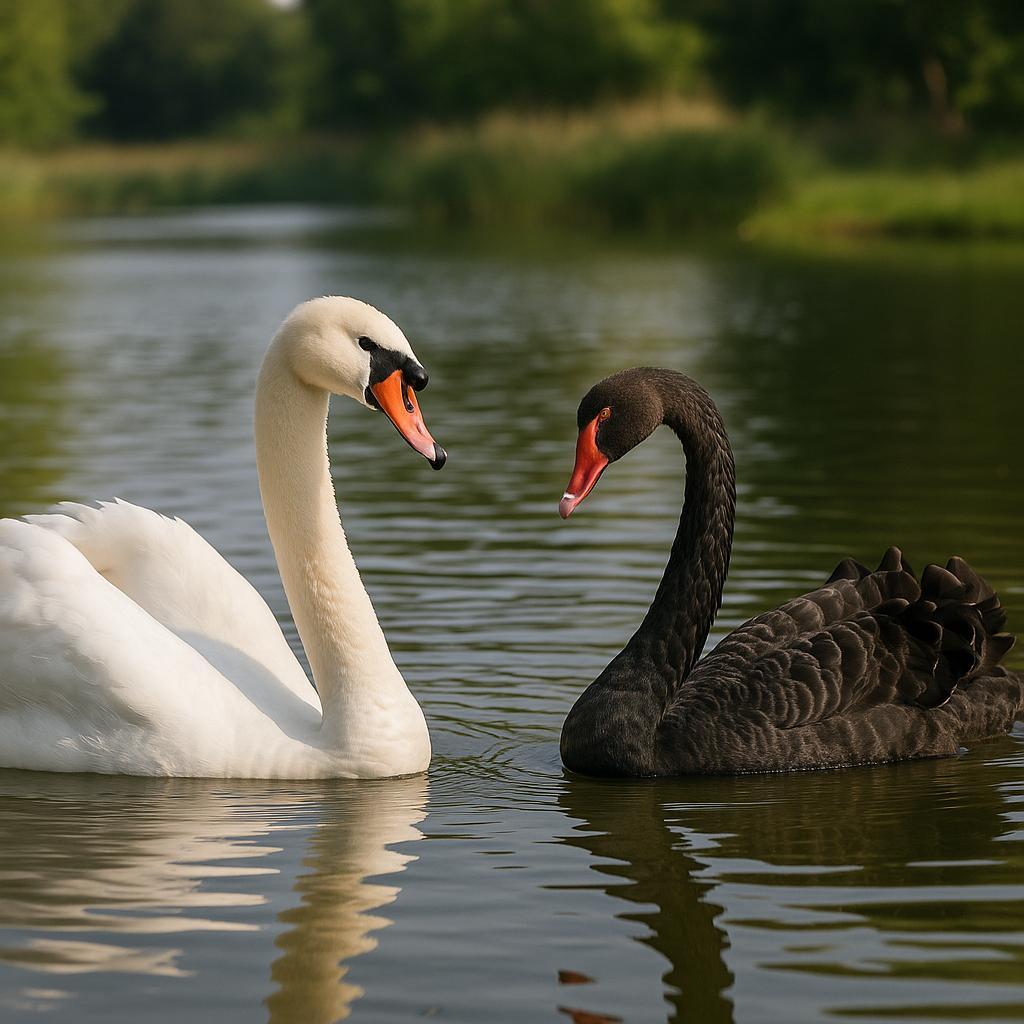
For centuries, Europeans believed that all swans were white. It wasn’t a controversial opinion. It was, in fact, seen as a certainty. The statement “all swans are white” was used as a textbook example of a universal truth, until it wasn’t. In 1697, Dutch explorers encountered a black swan in Australia. That single bird did more than surprise, it dismantled a long-held assumption, exposing the fragility of knowledge built on limited experience. This simple encounter now serves as one of the most powerful illustrations of a deeper philosophical problem: the recursive structure of assumptions and the failure of induction.
What Is a Swan? The Problem of Definition
Before black swans were known to Europeans, a “swan” meant a large, elegant, white bird. But what defines a swan? Is it its whiteness, its long neck, its behaviour, or something else? The moment we encounter a black swan, the definition collapses. We are forced to either:
- A) revise our assumption (“not all swans are white”), or
- B) redefine the category (“swans include black variants”).
This isn’t just about birds. It’s about how we structure reality through language and concepts. Definitions are not static, they’re built on assumed properties that can be overturned by a single observation.
The Limits of Induction: A Lesson in Surprise
The black swan also perfectly demonstrates the weakness of inductive reasoning: the process of forming general rules based on repeated observations.
- We see hundreds of white swans.
- We assume: all swans must be white.
- But assuming one black swan exists is all it takes to falsify the universal claim.
As philosopher Karl Popper noted, no number of observations can prove a universal statement true, but a single counterexample can prove it false. In terms of Assumptology, this means that if we assume all swans are white, and then encounter a black bird that we still wish to categorise as a swan, we must adjust our assumed definition. The falsifying observation doesn’t merely negate a fact, it recursively forces a reconfiguration of the assumptions underlying the concept itself.
This fragility is not a flaw in the black swan, it’s a flaw in how humans build knowledge when they forget the assumptions underneath.
The Biological Reality: Not All Swans Are Equal
Scientifically, black and white swans are not the same species. The black swan (Cygnus atratus) is native to Australia, while the white mute swan (Cygnus olor) is common in Europe. Though they belong to the same genus (Cygnus), they are reproductively isolated: they rarely interbreed, and when they do (in captivity), the offspring are often sterile or non-viable.
So why do we still call both “swans”?
Because humans don’t strictly follow biological taxonomy in daily life. We rely on conceptual categories that are often shaped by appearance, behaviour, or convenience. This is what philosopher Ludwig Wittgenstein called “family resemblance”, we group things not because they share one essential feature, but because they resemble each other in overlapping ways.
Linnaeus and the Birth of Classification
Carl Linnaeus, the 18th-century Swedish naturalist, revolutionized biology by creating the binomial nomenclature system: genus and species. This formalized taxonomy and allowed for precise distinctions like Cygnus olor vs. Cygnus atratus. Linnaeus gave us the tools to distinguish swans biologically, but language and society still operate on a different plane.
This is a case where scientific categories and everyday concepts diverge, exposing how our assumptions shift depending on context.
Taleb’s Black Swan Event: The Metaphor Expands
In modern times, Nassim Nicholas Taleb reintroduced the black swan as a metaphor for rare, high-impact, and unpredictable events. A “black swan event” is something that:
- Lies outside regular expectations,
- Has massive consequences,
- Is rationalized after the fact.
Financial crises, pandemics, the rise of the Internet, none were predicted by most models, yet all reshaped the world. Taleb’s insight echoes the deeper philosophical point: our models are built on unspoken assumptions, and these assumptions break under stress.
Recursive Assumption Management: The Core Insight
What the black swan illustrates is not just the failure of prediction, but the need to recursively examine our assumptions:
- We assumed all swans were white.
- One contradiction forced revision.
- We didn’t discard the concept, we restructured the assumptions underneath it.
This is the essence of Assumptology: truth is not fixed, but constructed through recursively adjusted assumptions. Concepts survive not because they are accurate, but because we are willing to stretch and revise them.
Are They Really the Same? A Philosophical Dilemma
So are black and white swans really the same?
- Biologically: No. They are distinct species.
- Linguistically: Yes. We still use the same word.
- Conceptually: It depends on your framework.
This is the power, and danger, of assumptions. Our categories feel natural, but they are artefacts of recursive compromise. Had black and white swans been reproductively compatible, the concept would feel more biologically valid. Since they are not, our insistence on sameness is a convenient fiction, one that exposes the flexibility and instability of meaning itself.
Conclusion: The Bird That Broke the Frame
The black swan is not just a rare bird, it is a philosophical bombshell. It teaches us that definitions are fragile, induction is unreliable, and assumptions are recursive. Whether in biology, language, or markets, the lesson is the same:
Every certainty is built on layered assumptions. One anomaly can unravel the whole structure.
We cannot escape assumptions, but we can learn to see them, test them, and revise them. That’s what the black swan demands of us.