Why assumptology?
Why assumptology?
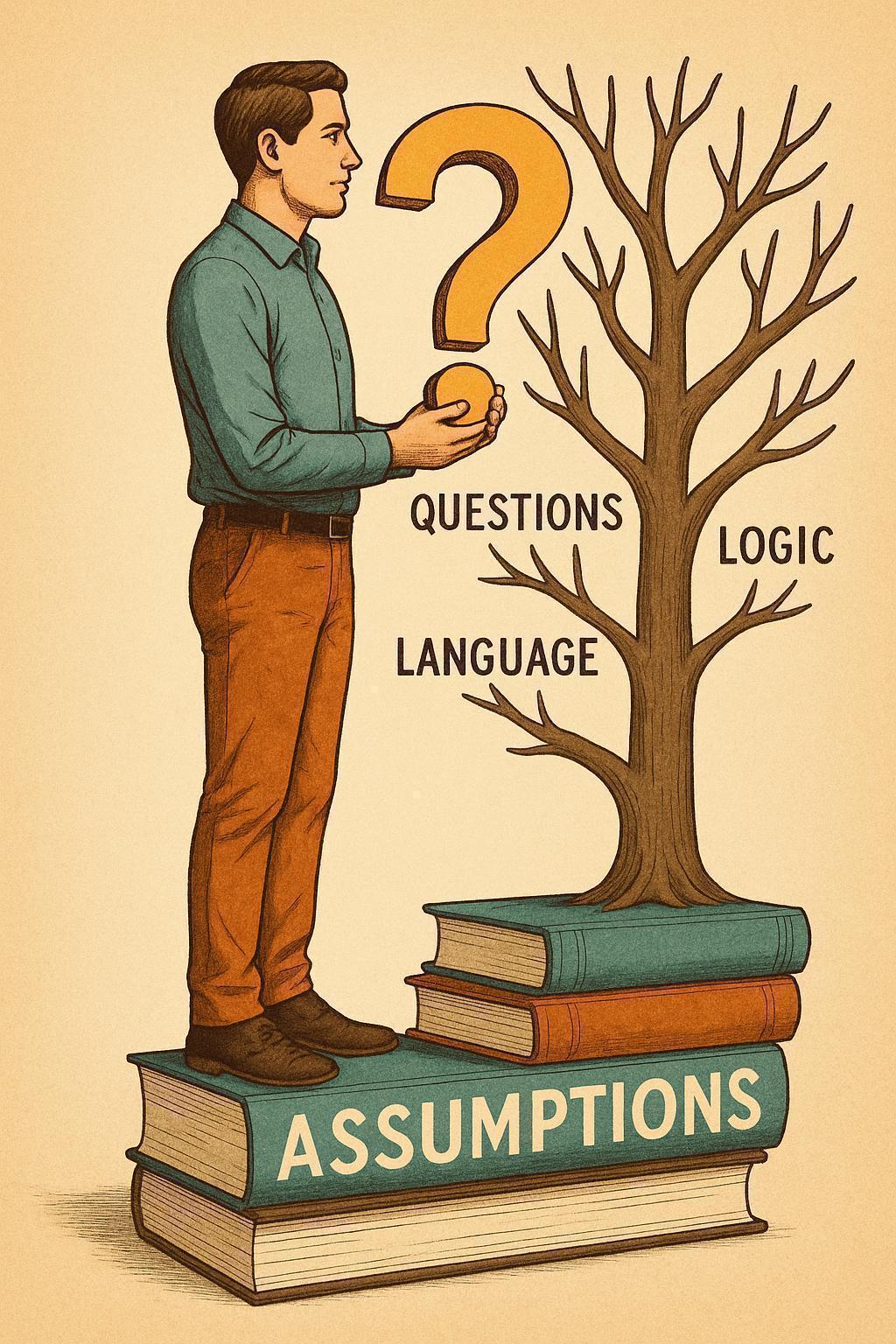
Instead of starting with a dry definition of assumptology, I’ve chosen to follow the advice in Simon Sinek’s book title: Start with Why. This is the story of how I came to create the field I now call assumptology, the study of assumptions, an idea named with a bit of help from ChatGPT, and shaped by years of questioning, reading, and personal experience.
After completing my studies in Sweden, I found myself at a crossroads. With two M.Sc. degrees, one in Engineering Physics and one in Finance, and four peer-reviewed research articles published, I felt well-equipped intellectually but unsure of what direction to take next. It was the spring of 2010 when I came across an article in a Swedish business magazine about pension calculations. As I read it, I noticed that the author’s conclusions relied on assumptions I believed were flawed. I picked up the phone, called the author, and pointed them out.
That phone call unexpectedly sparked a friendship. He later sent me a book about Warren Buffett, and we met at his office in Stockholm. But despite these interactions, the big question lingered: What should I do with my career? Around the same time, I read the excellent book Seeking Wisdom by Peter Bevelin. Inspired, I wrote him a long letter describing my experiences and my sense of directionlessness. His reply included a quote from Warren Buffett:
Do what turns you on. Do something that, if you had all the money in the world, you’d still be doing it. You’ve got to have a reason to jump out of bed in the morning. Don’t look for the money. Look for something you love, and if you’re good, the money will come.
Life, of course, carried on. I moved from Sweden to London and began working in a startup. Since then, I’ve worked across the tech industry in various roles, always driven by a passion for learning. Much of what I had learned in university quickly became obsolete, replaced by a continuous process of on-the-job education. At first, my main learning sources were still books. But when MOOCs like Coursera emerged, I eagerly took courses in machine learning and computer science. Over time, my learning evolved again, towards blogs, YouTube, and more interactive formats.
About six years ago, I became increasingly fascinated with the concept of questions, how asking better questions could lead not only to better learning, but a better life. I began reading extensively about the topic, eventually stumbling upon the field of erotetics, the logic of questions and answers.
One of the early and most impactful books I read was R.G. Collingwood’s An Essay on Metaphysics. It wasn’t an easy read, and I’ll admit I didn’t finish it in one go. But one idea stood out to me: the distinction between absolute and relative presuppositions. Collingwood argued that questions and answers are governed by assumptions, some of which are actively questioned (relative presuppositions), while others remain unchallenged in the background (absolute presuppositions).
Each person, each profession, and each intellectual domain operates under its own set of absolute presuppositions, assumptions so ingrained that they’re rarely, if ever, examined. This insight pushed me deeper into exploring the logic of questions, but over time I realised something more fundamental: assumptions themselves deserved to be the primary focus.
While Collingwood’s theory had its critics, I found something powerful in it. Over the years, I read widely, Socrates, Aristotle, Collingwood, Peirce, Frege, Quine, Dewey, James, Gödel, Feibelman, Russell, Wittgenstein. As I dug deeper, a turning point came when I asked myself: What was the first question? But I quickly realised I couldn’t answer that without making a series of assumptions: What defines a question? What does “first” mean? In what context?
That insight was crucial. It made me realise that assumptions come before questions. They form the substrate on which logic, inquiry, and even language are built. I started to see that presuppositions, suppositions, and assumptions were not just background conditions for reasoning, they were the foundation itself.
I began to imagine: What if we treated assumptions as a formal object of study? What if there were a kind of science or philosophy of assumptions? That idea became assumptology.
Another influential idea came from Quine and Ullian’s The Web of Belief. While I was less keen on framing everything as “beliefs”, a term too tied to psychology and subjectivity, I saw that what they were really describing was a network of assumptions. Beliefs, to me, are a subset of the broader, more universal category of assumptions.
Through this lens, I began to realise that every philosophy, every theory, every worldview begins with a particular set of assumptions. That’s why they can differ so wildly and yet still be internally consistent.
At this point, it might seem like assumptology is purely an academic curiosity. But that would be a mistake. In my view, identifying and analysing assumptions is not just intellectually interesting, it’s one of the most practical tools available for improving how we think, how we ask questions, and how we solve problems.
In an age increasingly shaped by artificial intelligence, even large language models can be tasked with extracting assumptions from text. This reinforces the idea that assumptions aren’t just abstract or philosophical, they can be operationalized.
I don’t claim that assumptology is the ultimate framework or final truth. But I do believe it’s a powerful lens, useful both in the most rigorous academic contexts and in everyday decision-making. So I invite you to join me in exploring how far we can go with this idea. Perhaps, by better understanding our assumptions, we can become better thinkers, and lead better lives.
I hope that you, the reader, will be inspired to follow along on this journey, taking Warren Buffett’s words to heart, to improve your life by exploring the structure and power of assumptions together.