Assumptology Case Study: The Palme Murder, Part 1
What We Know, and What We Assume
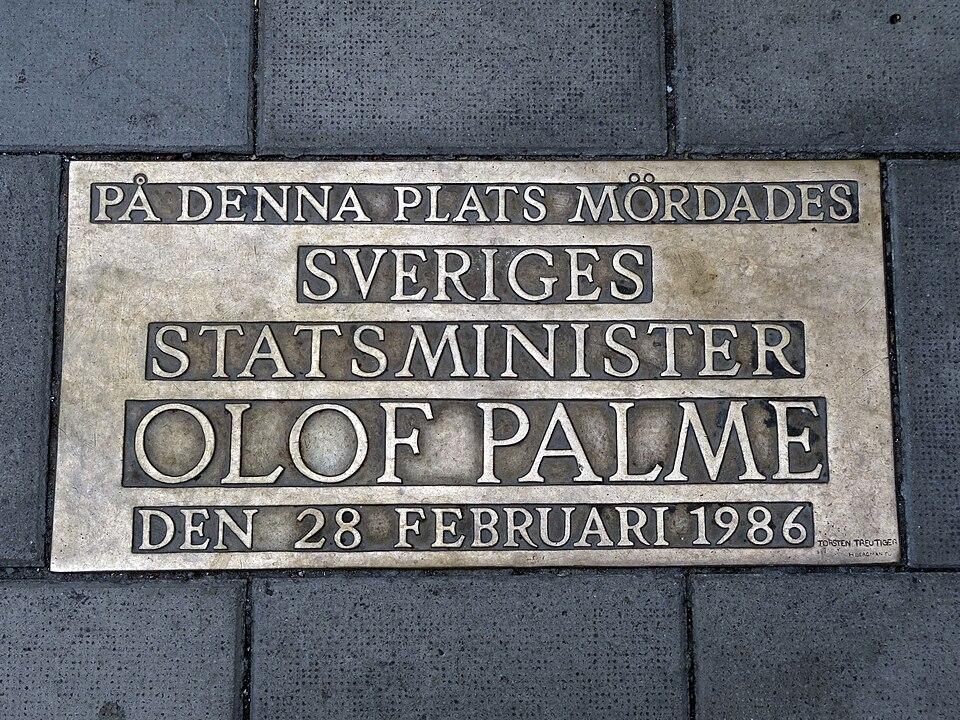
Part I, The Setup
On 28 February 2026, it will be forty years since Olof Palme, the Swedish prime minister, was assassinated on an open street in the middle of Stockholm.
That Friday evening in 1986, Olof and his wife Lisbeth decided, at relatively short notice, to join Olof’s son Mårten and his girlfriend Ingrid at the Grand cinema in central Stockholm to see The Mozart Brothers (Bröderna Mozart).
After the film, the two couples stood outside discussing whether to take a taxi or walk home. Palme preferred to walk, and the Palmes began heading south along Sveavägen.
At 23:21, near the corner of Sveavägen and Tunnelgatan, a man approached from behind and fired two shots. The first shot struck Olof Palme and proved fatal. The second shot passed extremely close to Lisbeth Palme, grazing her and causing an injury to her back.
After firing, the shooter hesitated briefly, seconds, not minutes, then ran up Tunnelgatan and disappeared into the night.
An ambulance arrived within minutes. Paramedics treated Palme at the scene and then rushed him to Sabbatsberg Hospital, where he was pronounced dead shortly after arrival. There were several witnesses in the immediate area.
How do we even know these things?
A reasonable objection appears immediately: How do we know any of this is true?
Most of us weren’t there. What we have is a reconstruction assembled from records: witness statements, emergency response logs, medical documentation, investigative summaries, and later retellings.
Assumptology doesn’t treat this as a reason to despair. It treats it as a normal feature of inquiry: facts become “facts” because they are settled by a convergence of sources and institutions. A claim becomes relatively certain when multiple independent channels point to the same event in a way that is hard to replace with an alternative story.
That is why we begin with the minimum timeline. Not because it is metaphysically indubitable, but because it is what the inquiry community, medical personnel, police, courts, journalists, and the public, has largely treated as settled over time.
There will always be fringe alternatives that deny even the core event. We don’t need to litigate them here. What matters is the method: if someone challenges the basics, the question becomes which settlements are being rejected, and what would replace them? What new chain of evidence would be required to make the alternative story intelligible?
That question, what would it take to overturn a settlement?, is one of the reasons the Palme case is such a good Assumptology example.
Why this case behaves differently
The Palme murder is often told as a whodunit. But it’s also a case study in how inquiries work, how “facts” become settled, how evidence is filtered, and how different closure standards produce different outcomes.
Part of the reason is simple: Palme wasn’t a normal victim. He was an unusually prominent and polarizing political figure, both domestically and internationally. That matters because it changes the shape of the inquiry before any evidence is even evaluated. A typical street homicide defaults to local explanations. A politically charged assassination immediately makes broader explanations thinkable, including international involvement, whether or not those branches ultimately prove correct.
There’s also a quieter feature that matters just as much: a standing background assumption in Swedish political life at the time, call it a normality regime, that the prime minister could move relatively freely. In other words, the event did not require a sophisticated breach of a hardened security perimeter. It could occur because the perimeter was, by design, thin.
Those two background commitments, high-profile target plus ordinary movement, are exactly the kind of upstream structure that Assumptology tries to make visible.
The Assumptology lens
In Assumptology terms, we separate:
A (Background assumptions): the silent world-model that makes certain explanations feel admissible or inadmissible (political vs random, domestic vs international, “this could happen” vs “this is impossible”).
D (Data): what is observed or recorded (witness statements, timelines, physical traces).
R (Rules): the interpretation machinery (what counts as credible testimony, what counts as a valid inference, what gets excluded).
σ (Closure): what counts as “solved” (a conviction, a prosecutorial conclusion, or simply public acceptance).
These aren’t four separate lists. They fit together. A shapes what investigators look for, R shapes how D is interpreted, and σ decides whether the inquiry is allowed to stop.
The Palme case is a rare example where these closure standards never fully converge: something can look solved in media terms, fail in court, and still be closed administratively, without producing the kind of certainty people intuitively expect.
The question that ends Part I So the real question that follows the scene is not “who did it?” It’s:
How do you even search for a suspect, and what would count as an answer?
Do you start from opportunity (who could have known the plan), intent (who had motive), means (who had access to the weapon type), or testimony (who was seen where)? And which background assumptions are silently steering that choice?
Part II starts where the web becomes unstable: eyewitnesses, identification, and the first major closure conflict.