Assumptology Principles
Assumptology Principles
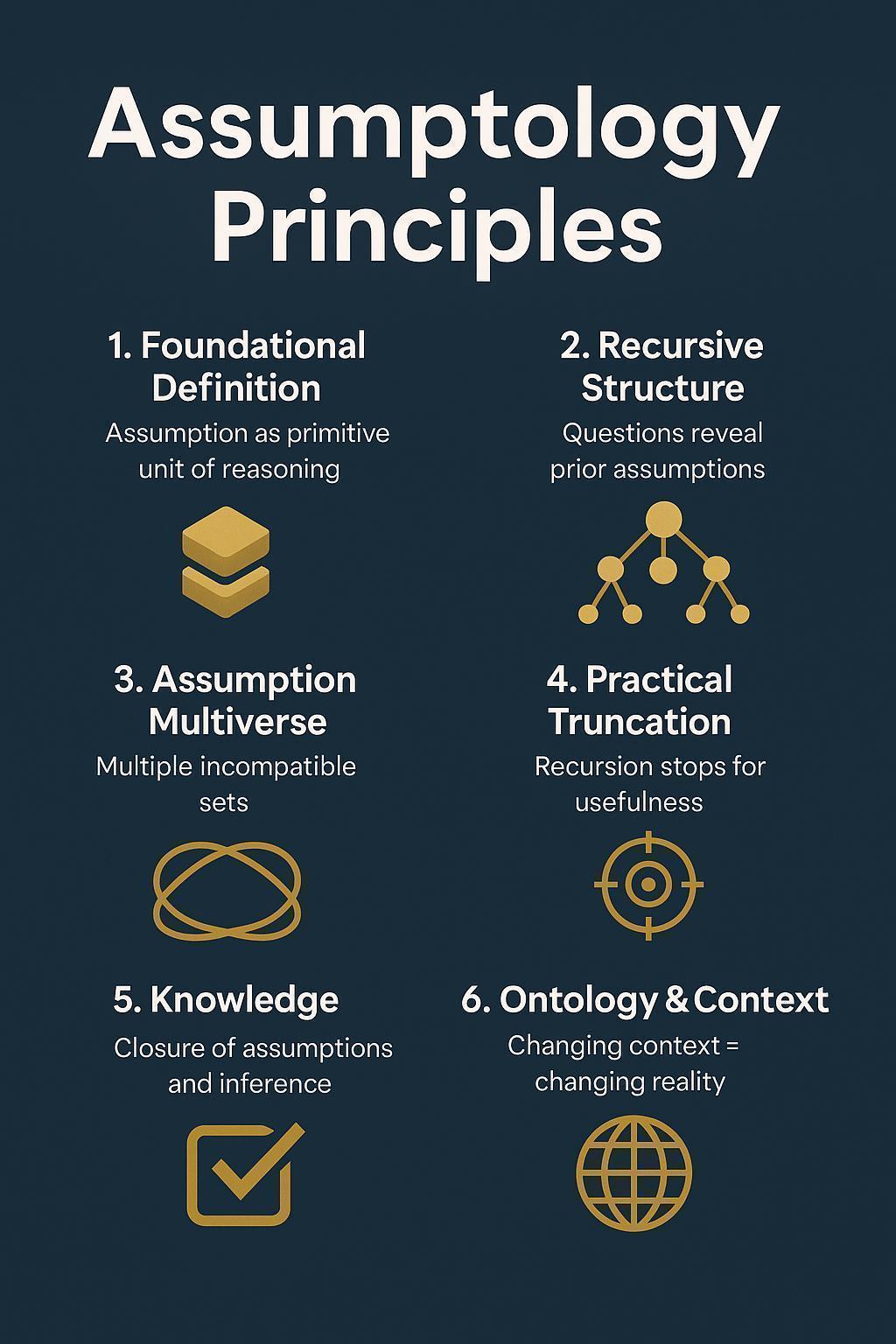
1. Foundational Definition: Assumption as Primitive
Assumptology should formally define an assumption as the primitive unit of reasoning, more fundamental than:
Assertions (which require assumptions to be expressed),
Questions (which presuppose assumptions),
Logic (which is structured on assumed axioms),
Language (which encodes assumed meanings).
Definition: An assumption is a chosen placeholder for truth, enabling the formation of statements, questions, or models.
2. The Recursive Structure of Assumptions
The core insight is that any assumption can be questioned, revealing its dependence on prior assumptions. This creates an infinite regress unless truncated. This gives rise to:
The Assumption Tree / Web: A hierarchical (or networked) structure where every node is an assumption, and its children are the assumptions that justify it.
Stopping Rule: The “truth” or “belief” is where recursion stops. This aligns with Peirce’s “truth is the end of inquiry.”
3. Assumption Multiverse
There is not one “correct” set of assumptions. Instead, reality is better modelled as a multiverse of assumption sets, each producing internally coherent but externally incompatible worldviews.
This gives rise to a new kind of epistemic relativism, but bounded and analyzable through the structure of assumptions, not loose opinion.
4. Practical Truncation and the Role of Pragmatism
While recursion could go on forever, pragmatism is the strategic decision to stop at useful points. You don’t seek perfect foundations, you seek foundations good enough to act.
This echoes Peirce but with a sharper edge: “Utility defines the depth of recursion.”
You can make this formal: Utility = f(depth, clarity, coherence, risk).
5. Knowledge
You might consider a base formula like this:
Knowledge = Closure(Set of Assumptions, Rules of Inference)
This provides a foundation to:
Compare philosophical systems (by assumption set),
Compare AI models (via training assumptions and logic architectures),
Analyse strategy and decision-making (by which assumptions are held fixed).
6. Ontology, Context, and Meta-Layers
Assumptology naturally supports a meta-ontology: not just what is, but what must be assumed in order to say what is. This lets it transcend domain-specific ontologies.
Also:
Context is an active assumption set.
Changing context = changing assumptions = changing reality.