Assumptology Case Study: The Palme Murder, Part 3: Witnesses
What human sensors can reliably output, and how narrative, memory, and closure pressure manufacture identity
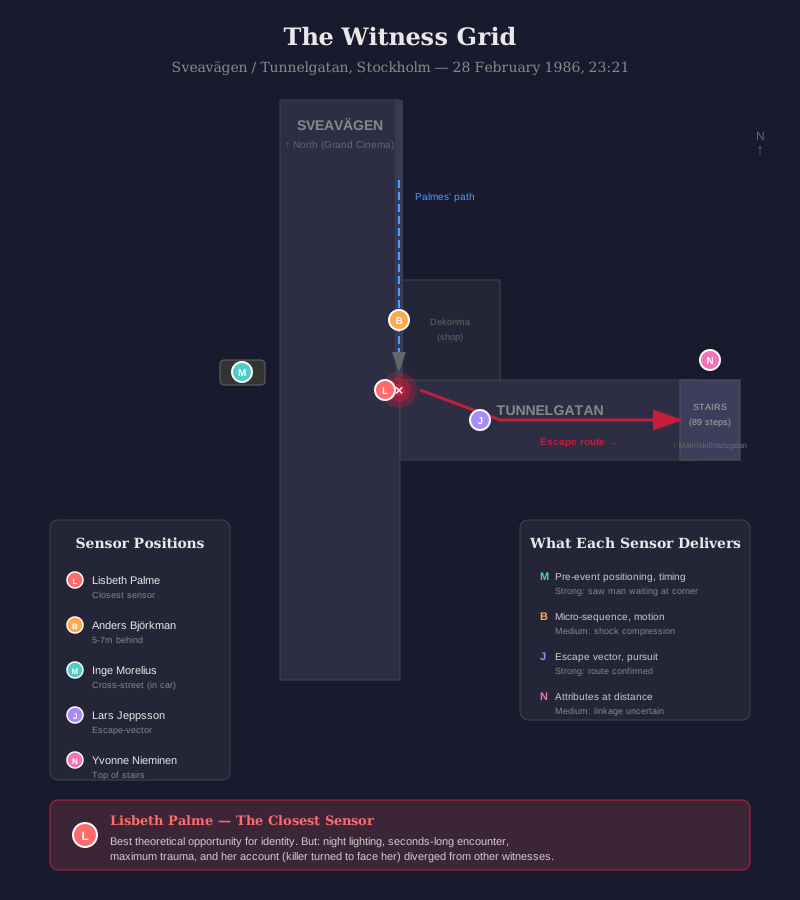
Here is the paradox of witness evidence:
The longer a case runs, the more confident witnesses become, and the less their testimony can be trusted.
Memory does not simply fade. It gets filled in. Witnesses absorb media coverage, hear theories, retell their accounts, and each retelling strengthens the coherence of the story. Certainty rises. But certainty is not accuracy. What felt like “I think I saw” in the first week becomes “I clearly remember” by the first year.
The Palme case ran for thirty-four years.
This post is about what witness evidence can actually deliver, what it hallucinates when pressured, and why the Palme investigation shows a common failure mode:
We ask human sensors for identity closure, when the layer can mostly deliver structure constraints.
The Assumptology frame
Before the case, the terminology:
- D (Data) = what a witness actually registered (motion, direction, timing, coarse attributes)
- R (Rules) = how we convert D into conclusions (“therefore he was the killer”)
- A (Assumptions) = what we silently presume (lighting quality, linkage between observations)
- σ (Closure threshold) = when we decide “good enough” and stop exploring branches
The witness layer is not broken. It is typed. It produces certain outputs reliably and others poorly. The failure is in asking it for something it cannot provide, and then building a case on the answer.
The night
28 February 1986. Olof Palme and his wife Lisbeth leave the Grand Cinema on Sveavägen around 23:15. They have dismissed their bodyguards. They walk south, cross the street near Adolf Fredrik Church, pause to look in a shop window, continue towards Tunnelgatan.
At 23:21, a man approaches from behind. One shot into Palme’s back. A second shot grazes Lisbeth. The man flees east down Tunnelgatan, up eighty-nine steps to Malmskillnadsgatan, and disappears.
More than twenty-five people come forward as witnesses.
The witness grid
Instead of treating witnesses as narrators, treat them as sensor positions, each with different strengths and failure modes.
Cross-street sensor: Inge Morelius sits in his car on Sveavägen, waiting for friends. He watches a man in a dark coat stand at the corner for several minutes before the shooting, then approach the couple from behind. Stable viewpoint. Good for timing and pre-event positioning. Weak for facial detail.
Close-proximity sensor: Anders Björkman walks five to seven metres behind the Palmes. He sees the shooter put his hand on Palme’s shoulder and fire. Maximum proximity, but also maximum shock. He seeks cover at a storefront within seconds.
Escape-vector sensors: Lars Jeppsson is walking on Tunnelgatan when he sees Palme fall. The killer runs directly past him. Jeppsson pursues up the stairs. At the top, he meets Yvonne Nieminen and Ahmed Zahir, who have also seen a tall man in a dark coat run past, slipping on snow, looking back once or twice. Strong on route. Weak on identity.
The closest sensor: Lisbeth Palme. Standing beside her husband when he is shot.
What the layer delivers
Structure (strong)
The witness layer converged on structure even where it diverged on everything else.
Multiple sensors independently registered the same escape backbone: east down Tunnelgatan, up the eighty-nine steps, continuing towards David Bagares gata. Time-stamped radio chatter anchored the sequence: first emergency call at 23:22:20, taxi switchboard alert at 23:23:40, first patrol on scene by 23:24.
Witnesses converged on motion quality. Early statements described the killer’s movement as “smooth, efficient, and powerful.” Björkman: “resilient steps,” “a leisurely pace.” Morelius: “calm and professional, almost like an elite soldier.” The escape route, up stairs that disabled car pursuit, suggested familiarity with the area.
This is real output. It constrains the event even when it says nothing about identity.
Pre-event positioning (medium)
Morelius reported watching the man stand at the corner of Sveavägen and Tunnelgatan for several minutes before the Palmes arrived. When they approached, the man fell in behind them.
Another witness described the impression that three people were travelling together, Palme, Lisbeth, and the man just behind, close enough to look like a group.
If accurate, these observations make “spontaneous impulse” models more expensive. Pre-positioning implies planning. The killer may have been tracking the couple.
The disciplined move: don’t believe these observations, but keep them live until pruned by stronger constraints.
Coarse attributes (medium)
Male. 30–50 years old. Approximately 180–185 cm. Dark coat, possibly knee-length, several witnesses noted it “fluttered” as he ran. Knitted cap.
Useful for exclusion. Not useful for identification.
The Lisbeth problem
If anyone should have been able to identify the killer, it was Lisbeth Palme.
She was standing beside her husband. The shooter approached from behind, fired, and, according to her account, turned to face her after the second shot before fleeing. A direct view of his face. The closest sensor. The best theoretical opportunity for identity closure.
Now consider the conditions:
23:21 on a February night in Stockholm. Street lighting, not bright. The encounter lasted seconds. Her husband had just been shot beside her. She had been grazed by the second bullet. The shooter was in motion, approaching, firing, turning, fleeing.
And here is the detail that should stop any easy confidence:
Multiple other witnesses described the shooter fleeing without turning. They saw only his profile or the back of his coat as he ran into Tunnelgatan.
Either Lisbeth saw something others missed, she was closer, the turn may have been brief, or the “turning to face her” is a reconstruction. The brain filling in a face-to-face moment that would make sense of the trauma.
This is not a claim that Lisbeth was wrong. It is the observation that we cannot know from the witness layer alone. The closest sensor, with the best opportunity, under the worst conditions, produced output that diverged from other accounts on a key detail.
That is the condition we are in.
The attachment problem
The Lisbeth divergence points to something deeper.
In street events with low light and fast motion, faces are a luxury variable. The widely circulated police sketch, released a week after the murder, was later determined to be based on a witness who probably never saw the killer at all.
But weak description is not the core problem. The core problem is attachment:
A witness may accurately describe a running man and still attach him to the wrong event node.
Sveavägen is a major thoroughfare. Late Friday night. Multiple people moving through the area. The killer was not the only person who could run, wear a dark coat, or glance back over his shoulder.
Jeppsson pursued a man up the stairs. Nieminen saw a man at the top. Same man? The descriptions are compatible. But compatible is not identical.
Lisbeth saw a face. Was it the face of the man who fired, or someone else in those chaotic seconds?
Attribute-rich does not mean event-linked.
The contamination layer
A witness statement is produced once. It is re-produced many times, in retellings, interviews, reflection, and exposure to narrative.
The Palme murder was a national trauma. Coverage was relentless. Witnesses did not experience their memories in isolation. They experienced them alongside theories, suspect profiles, and interpretive frames that told them what mattered and what fit.
How D becomes D′
The original observation is D. But over time, witnesses absorb a background model: what kind of person “normally” commits this act, what weapon is “usually” used, which details are “important.”
They re-encounter their own memory under a new interpretive regime. The press supplies A (assumptions) and R (rules), and future retellings become D′, data shaped by later framing.
D → (media-driven A/R) → D′
Here is a concrete example from the Palme case:
Early witness statements described the killer’s movement as smooth and controlled. But over time, particularly after certain suspects emerged, some witnesses began describing the killer as having “walked with a limp or otherwise clumsily.”
The descriptions drifted towards the profiles being circulated. Not because witnesses were lying. Because memory is not a recording. It is a reconstruction that borrows from available materials.
The reconstruction problem
When a detail is missing, the brain fills it in. “If he ran that way, he probably turned here.” “If I was close, I must have seen his face.” “If he shot someone, he must have looked angry.”
The reconstruction feels like memory. It carries the same subjective weight. But it is inference misfiled as observation.
A witness moves from “I didn’t see X” to “X wasn’t there” to “I remember that X wasn’t there.”
That is closure drift.
The disciplined posture
Read the witness layer for what it can deliver:
- Structure: escape route, timing, sequence, strong
- Motion quality: smooth, professional, familiar with terrain, strong
- Pre-event positioning: possibly waiting, possibly tracking, medium, keep live
- Coarse attributes: height, build, clothing, medium, useful for exclusion
- Identity: weak, no stable facial observation, contested details, high contamination risk
Treat early statements as closer to raw D. Treat later statements as higher-coherence but higher-contamination. Separate observed from inferred, even when inference seems reasonable.
And remember:
A witness is not only a sensor of the event. Over time, they become a sensor of the narrative about the event.
What the layer concludes
The Palme witness layer, read honestly, outputs an unsettled web.
Strong constraints on structure: the escape route, the timing, the motion quality, the possible pre-positioning. These hold.
Weak constraints on identity: no witness observed the killer’s face in stable conditions. The police sketch was wrong. The closest sensor, Lisbeth, had the best opportunity but operated under maximum trauma, and her account diverged from others on whether the killer turned to face her.
That is not investigative failure. That is what human sensors produce when read without forcing closure.
The investigation would go on to name suspects. Conduct lineups. Go to trial. The witness layer, above all, Lisbeth’s identification, would be asked to do something it was never designed to do: put a name to a face that no one clearly saw.
What happens when evidence like this meets an institution whose entire purpose is to force closure?
That is the next question.